Wednesday, May 29, 2013

Arsehole


In the supermarket I found myself in the queue behind a guy in a suit. He was young, maybe thirty, short black hair, smelled of something expensive. I don’t know what he’d come in for, but all he was going out with was a bottle of Diet Coke.

He was talking to a woman, a little older than him, in one of those sensible, conservative work dresses. She had a lot of folders and papers with her. She clutched them to her chest and moved her weight around on one heel. Signs of preoccupation. She asked him how his work was going.

One question was all it took.The young guy had just got a promotion. He was managing something now. I couldn’t catch what because at that moment some kid nervously asked me to move so he could take a tower of baskets from underneath the checkout.

When I refocused, the guy in the suit was still talking. New responsibilities. Departmental problems. People he was dealing with who weren’t pulling for the company. His face glowed as he relayed all this like a dad telling someone about the trophy his daughter won at sports day. Except he was the dad and the daughter.

Paying for the Diet Coke with a twenty pound note, he asked the shy, rheumy-eyed woman at the till to give him his change in specific denominations and certain quantities of different coins. “I’m not being very helpful am I?” he asked, stylishly, half-winking at his companion.

It was my turn at the checkout next. I was buying breakfast cereal, some chewy bars and a new journal. The cost of this princely haul £4.99. I gave her a fiver and thought about asking her to give me my change in one penny coins. But she looked too hassled to appreciate my satire.

On the way out of the supermarket I saw the man and the woman again. She was waiting for him as he argued with his mobile phone. He paced up and down, palming a cigarette, meeting his own floating clouds of cologne every time he retraced his irritable steps.

I had to pass close to them because they were so near the doors. She looked like she thought he was a total arsehole.

Tuesday, May 28, 2013

Because I Cannot Stop for Death (Right Now)

The first car that had to stop for me at the traffic lights on Barrack Road today was a hearse with a coffin in it. Is that what Emily Dickinson meant when she said, "Death kindly stopped for me"?

Hearing about this my poet friend Bryn Fortey said, "It's when they stop and offer you a ride..." Indeed it is. And I've seen too many people go with them for my liking in the last couple of years, not that any of them had much choice.

But as I told Bryn, they offered me a ride in the hearse last year when pneumonia laid me down and my lung collapsed. I was lucky, though. At that moment Michelle came along. She gave me a lift in her beat old yellow Fiat, and took me to the hospital instead of the grave.

I'm not ready to go anywhere with those grim-faced black-wearing behatted avatars of the void just yet. I've still got one great poem to write (and since I'll probably never do that, I can't ever die).

Monday, May 27, 2013

Satori on the Racecourse: An Encounter with Islam


I went out to the Racecourse just after dawn this morning for my usual fat-burn walk and communion with the spirits of the hanged and the butchered. They used to hang highwaymen here in the 1800s. Coming out and watching someone get hurled into the void at the end of a thick rope was the weekend equivalent of going to the football or staying home for the soaps. They had several thousand soldiers bivouacked on the same stretch of land in 1914, camping with their horses waiting for the call to go to France and get slaughtered in the trenches of World War I.

Sometimes when I’m in the park and the atmosphere is right, or my mind is right, I can see and hear it all. It’s as if psychic imprints of the soon-to-be-dead outlaws and the scared-shitless soldiers have been left on the trees and in the mud. Like yesterday: walking along the footpath near the kids' play area, I had such a spooky feeling of death, imminent death, I thought I was about to fall down and breathe my last looking up through the tree canopy at perfect blue sky. I’d only got a third of the way around the park but I immediately turned tail and went home.

Today was different. I was out at six (okay that’s not just after dawn, it’s about an hour after dawn) and I’d doped myself up on paracetamol to deal with an earlier headache; I have the constitution of a mouse, so two mild sedatives is enough to put me in a partial coma. No spirit-visions then. Just sudden paranoia. I thought, with a jolt, “Hang on, what the hell am I doing on the Rapecourse at six o’clock in the morning with no one to witness me being attacked by some knife-wielding lunatic looking for drug money?” (I knew they wouldn’t want my phone, but they might be interested in my wallet.)

I decided my fear was stupid. There was nobody about anyway. Then, with a frisson of something slightly worse than fear, I saw someone coming along the path. I drew a wide circle around him, not relaxing until I saw he was twenty or thirty yards behind me. And carrying a flask. Unfortunately, as I was approaching the basketball courts, I saw someone else; and he was behaving oddly. This guy, a brown-skinned fellow, was walking very very slowly along the court perimeter with his head bowed; he appeared to be talking to himself. And when he came to the corner of the court, he turned and walked back again. He looked stoned.

“Great,” I thought. “There’s no way I can avoid passing him now. What if he comes at me all crazy? Do I run? Fight?” I settled on fighting. I’m not a fighter; in fact, I’m a total coward – but I fight better than I run. I didn’t have to do either though. What I thought was happening (or would happen) was so far away from the truth I felt immediately stupid. At the other end of the court I saw another guy, brown-skinned like the potential mugger of my imagination. He had his hands clasped, his head raised up to the blue sky and he was reciting a prayer in some language I didn’t recognize.

I didn’t need to know what he was saying. The sight of this guy out in something close to nature worshipping his god was so beautiful in this capitalist machine nightmare we’ve made for ourselves I nearly stayed to watch him. I could almost feel something else revealing itself, something more than the everyday mundane material reality, because of the rhythms of his prayer and the fact of his reciting it here. But not undead soldiers or the hovering souls of hanged outlaws. Life! Eternal, boundless life beyond this decaying impermanent human form.Treating him like a sideshow, however, would probably have created some paranoia on his part or his mate’s – who it seemed, after all, was just waiting for him – and there’s enough paranoia going around in the country to keep everybody busy.

So instead of bothering either man, I put my head down and carried on walking. But I felt better for what I’d seen and I still do, a couple of hours after the event. Especially because it showed me that I had nothing to fear, that what I saw as a potential threat to my safety was a projection of my own anxiety based on what I thought I knew about the place I was walking through. The guy I expected to kill me was just killing time while his mate had a private moment with the divine; he was unaware even of my existence, although a fat, white blob might have briefly passed across the periphery of his vision. I'm not, in other words, that important, and what a terrific, funny lesson that is.

I wonder how much crap could be avoided in the world if we learned to tell the difference, all the time, between what’s real and what we’re making up, essentially to protect ourselves from an unreal threat?  

Sunday, May 26, 2013

Notebook Scribbles In A Summer Churchyard While Locked Out Of The Bard Gaff

You can never tell what's going to happen, brothers & sisters. What did happen is that on my second trip to the park I left the Bard Gaff w/out my keys. Now I'm sitting in the churchyard in the middle of town wondering if Michelle will see the text I sent her so I can take the short hike down the road to her job, pick up her keys & let myself in. I cd. be hanging around for hours! At least it's 17 degrees today. (Actually if I don't hear from her I'll just go to a pub. It wd. be qt. a nice way to spend my afternoon.)

The churchyard looks really beat right now. The grass hasn't been cut for a long time & the dandelions are standing tall & many in it. There are bits of deadfall under trees too - stuff broken off in the heavy winds we had a few nights ago. They never maintain this one too enthusiastically, but if they kept it like this it wd. be wonderful. W/ the venerable age of the graves, the few graves, spread out randomly  in the four great triangles of grass crossed by a cracked, blistered concrete footpath, the place looks like it was abandoned 50 years ago. & what treasures abandoned places hold.

A crow flying overhead w/ an almost lazy downward sweep of its wings.

The continual chirping & chirring of summer birds.

White butterflies floating over graves.

A cloud of midges blown across the tall heads of the overgrown grass.

Kids w/ short hair, polo shirts, unzipped hoodies & trackie bottoms, exchanging fags beside a bench in the furtive shadow of the church.

Saturday, May 25, 2013

The Lowdown

The morning mail brought with it news of a literary project by Robert M. Zoschke, an old writing pal. Called "The Lowdown", it describes itself as a "literary arts annual", and collects 42 writers and artists including such luminaries as Sharon Auberle, Lyn Lifshin, t. kilgore splake, Gerald Nicosia, A.D. Winans, Ralph Murre and Zoschke himself. There is also cover artwork by none other than Lawrence Ferlinghetti (and if you don't call that a coup you're pretty hard to please).

Following the sad passing of Norbert Blei this inaugural edition of "The Lowdown" will feature tributes to the much-missed Norb and a selection of his own writing. If you haven't read him yet, you should try. He really had an exceptional gift with the word.

Something I think he would have liked immensely is that proceeds from the annual will provide a student scholarship through the Karen Teskie Memorial Scholarship Fund at the Peninsula School of Art in Door County, Wisconsin. Norb was all about helping other artists express themselves and get their work out to the world.

You can buy "The Lowdown" for $23 including shipping inside the US. I don't know what Rob would need from you in Europe or elsewhere. Send cheques or money orders to Robert M. Zoschke, P.O. Box 38, Ellison Bay, WI 54210.

Wednesday, May 22, 2013

Piece on Ray Manzarek at Empty Mirror


It usually irritates me when writers and poets promote their own work as if there could be no more inspiring thing for a person to do than read them. But I relax my prejudice towards self-promotion when I'm the writer. I never claimed I was intellectually consistent. 

Right now I have a piece on Doors keyboard player Ray Manzarek at the fabulous Empty Mirror. I think it's rather good too, though I say so myself. Enrich your day by going over there for a look, and then, if you have time, explore the site. It's full of great arts-related/ Beat-inflected/ alternative-underground treasures.  

Sunday, May 19, 2013

New poem: Dawn Taxi


DAWN TAXI

At dawn, back in the red dress
which she’d bought at lunchtime yesterday
with a slight frisson of danger,
she felt just like the roses
that were dying on her steps at home.
Her head lolled in the dark rear
of the taxi that had picked her up
from the phone box near the school.
She straightened, took out her mirror,
and seeing what she expected,
she closed the mirror with a sigh.
The driver watched her furtively.
He wondered why she had no shoes

Friday, May 17, 2013

The Old Way


I found The John Lennon Letters (2012) in a charity shop the other day. Edited by Beatles biographer Hunter Davies, it’s a collection of letters (no surprise there perhaps), postcards, fan surveys filled in by Lennon, and even shopping lists retrieved from bins. Fascinating, if you like Lennon as I do, and soul-curdlingly tedious, I would imagine, if you don’t.

The book, though, as well as my thoughts about the recent passing of Norbert Blei and other poets (see previous post), has had me reflecting for a couple of days about how much I prefer communication done in what Gary Snyder calls "the old way".Face to face is best, of course, but if you can’t manage that, it’s much better to have a physical object like a letter or a card from someone than an email or a message on Facebook. E-communication has its uses, but it’s not warm; it doesn’t feel like you’re interacting with anything other than the device that the message is coming through.

Yesterday I opened a book and found a card from my mother. She left her body seventeen years ago, but here was a thing she’d gone out to buy, rested on her lap or on a table one quiet afternoon, written a message in and handed to me on the morning of my birthday. “Still my baby boy,” the message said, in the large block-lettering I knew so well. It made me cry, naturally, but it also reminded me how much I was loved once, by her, and how lucky I was to know such a beautiful, open-hearted woman.It gave a piece of our time together back to me. I don’t think a rediscovered note in my Facebook inbox would have had quite the same impact.

Wednesday, May 08, 2013

Norb Blei


Today I heard the sad news that Norbert Blei, a quiet hero of the American literary world, has died. He passed away on April 23rd in his beloved Wisconsin, leaving behind an immense body of work and the gratitude of thousands of authors and poets around the world whose writing he selflessly promoted. I was one of them.

I don’t remember how I got to know him. It must have been when I acquired a home computer for the first time, around 2003 or ‘4. But whether I submitted work to him or we just started corresponding and publication developed from that, I don’t know. It seems like there was a lot of literary activity back then. Letters and emails were passing back and forth between Hodder’s home at the Lookout and locations all over the world.

Norb was someone I even thought of as a friend, a long-distance friend. I have photocopies of lots of long emails he sent to me, which I will cherish now and keep safe in my archive in anticipation of the wider recognition of Norb’s work that must come, whether he would have wanted it or not. Yes, he was a friend. But then, around 2007, something happened. I stopped being able to write good poetry consistently. Work I’d sent to magazines and websites kept coming back. My confidence in my art shattered into a million tiny pieces.

It was breaking up with my girlfriend that did it. And loneliness. And burn-out at my care work job. (I was physically and mentally fried.) It was, ridiculously, my discovery of Facebook and all the time and energy I wasted on there. And it was my epilepsy diagnosis. It was everything. Most of all it was my insatiable need to have my ego massaged. If you don’t tell me I’m the greatest I become convinced I’m the worst. It’s childish, but a deeply buried reflex.

I was certainly too proud to tell Norb I was struggling. So I didn’t write at all. What the hell, I told myself. Norb doesn’t want to hear from an insecure care worker with literary pretensions he can’t live up to. But the one email I got from him in the long silence that followed suggested that he had wanted to hear. I’m sure I wasn’t the first thing he thought about when he woke up in the morning (it’s coffee or toilet for me), but when I did cross his mind, I think he felt I’d turned my back on him. Well, he wouldn’t be the first or the last to think that.

A year or two ago I started missing Norb and thought it was time to rekindle our friendship. I sent a series of haiku to his supreme internet page Basho’s Road; but they were probably shit, and he ignored me anyway. Maybe he just didn’t want to reject an old mate. He’d undoubtedly heard about my Facebook clash with a guy who we both knew. This guy told me I should write less politics and more poetry. I blew up at him because his tone was so patronising, and because he’d stuck a thumb in a really raw wound. The next time I looked I was no longer his friend.

It doesn’t do, as a poet, to offend publishers and editors. But when you start playing that game, they might as well “float you down the river with the turds,” as Bukowski so eloquently put it.

I’m saddened, now, to think of all those wasted days when my friendship with Norb could have flowered; when I could have been learning from one of America’s great writers about how to do this and how to say that. Other Voices, the book on my shelf that he edited, and which I have several poems in, is as much of a monument to the stupidity of my ego as it is to the relationship that culminated in its publication in 2007. But we had that relationship for a while, and whatever happened afterwards I feel that was a privilege.

I came along at a really magical time. Consequently I have known some of the greats, and too many of them these days are making their exit. Dave Church, Joe Speer, Todd Moore … they’re all gone. But somehow Norb Blei was supposed to be around forever, bearing everyone on his considerable shoulders like a Mount Rushmore of poets. Alas, he was flesh, bone and heart like the rest of us.

People wishing to mark Norb's passing can make a donation to the Norb Blei Memorial Literary Fund at The Clearing, PO Box 65, Ellison Bay, WI 54210 USA.

Monday, May 06, 2013

The Filth and the Fury: The Times Ain't Now but What They Used to Be


Last night ended with a gaiety it will be hard to match today. We sat down with our crack pipes and watched The Filth and the Fury, Julien Temple’s documentary about a beat group from the long-ago days called The Sex Pistols. And my head is still reeling with the marvellousness of what unfolded on the old elephantine tv in the corner of the living room at the Bard Gaff.

The Sex Pistols were, and are on the record they left behind, a great fucking band. In 1977, when they released ‘God Save The Queen’, I was just leaving primary school and starting secondary school. I didn’t know anything about them until I arrived at Westfield in Wellingborough, and when I saw pictures and heard their records I was terrified. They looked like the people who were picking on me in the corridors and the playground every day. That, of course, is because those nasty little maladjusted bastards thought that making someone’s life a misery was being very punk.

But rewind a moment. In The Filth and the Fury you see footage of people at those Silver Jubilee celebrations, street parties and union jack bunting everywhere. I was one of those people, improbably. In the summer between primary and secondary school they set out trestle tables on the lane between the church and my school in Little Harrowden and gave us fruit juice, cake and jelly. No doubt lots of flags were waved and some fool played the original version of ‘God Save the Queen’; I don’t remember. But talk about indoctrination. If you saw stuff like that happening in North Korea you’d be calling for air strikes against the revolting Commie dictator.

Now wind forward to 2012. People are at it again, gathering wherever they can to wave a flag whose very design is an emblem of the brutal suppression of once-sovereign countries; they’re weeping big sentimental tears about the monarch, who’s still here even though the Pistols are gone and Sid went to the worm farm so long ago no one even remembers his name. They’re so proud. They love their country. And the best answer anyone can come up with to that is an attempt, not supported by John Lydon, to get God Save The Queen by the Pistols into the download chart. (He didn’t want a great song to be used as a tokenistic act of dissent by people too dumb to speak for themselves.)

Jesus, though, how depressing. What happened between 1977 and 2012 to castrate artists so thoroughly they needed a 35 year old song to tell their story?

Rebellion became systematised. (Were the Pistols a rebellion? or a reaction?) It became a thing you do, a pose you strike, a way of packaging your butter. The last act I heard with talent and access to the airwaves who had something genuinely challenging to say were Public Enemy twenty years ago. Listening to their albums was exhausting, almost masochistic, because they were so intense; and Chuck D., like Lydon, had a fiercely independent, original mind that smashed through political, social and showbiz bullshit like a cannonball going through a wall.


There is the problem of mainstream access of course. The bigger media outlets hadn’t quite found a way of shutting down everything worth listening to in the Nineties, although they were half way there. Digital radio and the internet increase the diversity of what’s available to people, but trying to find a new Pistols or a new Public Enemy in the digital and cyber worlds is like looking for a penny in a million miles of grass. They may be out there; my generation was no more special than my mum’s, or her mum’s. But where are they? And what’s the chance of more than five people ever hearing about them, if that’s the goal?

Maybe it isn’t the goal. We saw in the Eighties what the commercialisation of pop music led to. Fucking Queen being elevated to the status of rock gods by Tory tv presenters and people who love “Emmerdale”.

When I listened to Lydon talking on The Filth and the Fury – I say listened because he’s photographed, appropriately, in shadow (it was never about celebrity) – I realized how much I am the product of a certain strand of thought that came along at a certain time in history. (Unless it’s just a similarity of temperament.) I was too young to know what the fuck was going on in ’77, but I felt exactly his exasperation about the Silver Jubilee during the Diamond Jubilee; and the Olympics drove me up the bloody pole. What is it about people that they want to indulge in public displays of subservience and bad taste with millions of others who look and dress exactly like they do?

My attitude was dismissed as grumpy, as an indicator of the rigidity of middle age, by people reading my writing here and on Facebook. I’m some sort of old crank party pooper, according to people who would rather live their lives on one knee hoping for a crust from the lord of the manor. But that’s not it at all. I always knew that the things I say are true, or at least, I did when I was old enough to start thinking for myself. I just didn’t always have the words or the self-confidence to express my opinion.

I've got bucket loads of words and confidence now. Which is probably why my readership has fallen off a cliff.


Monday, April 29, 2013

AT UNI, FEBRUARY 2011


It’s Thursday morning. I’m at the Uni early,
sending emails from a free computer
to poets in Kentucky, Michigan, New York.

This black kid’s talking to a pink-skinned kid
with spots, and twisting teenage angst.
The former’s got a gold chain round his neck,

and a giant watch. He’s doing all the talking.
“If you want it, man, you gotta work for it.
I want it all: the house, the car, the swimming pool.”

It's thirty years since Thatcherism, and still they talk
that crap. Nothing marks you out more clearly
for a life of scrubbing round for pence.

I’ve got to get away from them. In the canteen,
Deutschland’s sitting by himself, ipod wires dangling,
a metal band like ants brawling in his earphones.

Then Jess comes, armed with Lucozade and Skittles,
and Martyna, due in three months, sits and sighs.
We all agree that we’re too tired for class.

Jess shows the sandwiches her mother made.
They’re wrapped at least twice round in clingfilm.
“My Mummy loves me,” she beams, carefully unwrapping.

Martyna dreamt she gave birth to a girl
in a hard cocoon, but with the mouth stuck out.
It was more a snout, she smiles, but wet enough for kisses.

She takes her pad and draws a half-thumb shape,
with piggy nose and wide, believing eyes.
“My baby,” she says, as if she’s worrying

she might really have this little alien.
We laugh, and I move sideways for the cleaner,
who’s sweeping up our crumbs. I say thanks,


and sorry. I don’t like people picking up for me.
The young socialists at the window table
boom with laughter as she brushes round them.

I’m remembering my mum, and the better, fairer world
she worked for. It won’t come from those spoiled brats.
Or me, the willow on the quad accuses.

                                   - February 2011/ April 2013

Saturday, April 27, 2013

LAST DAYS OF THE CHEESY BANDIT KID: HOW BARD GOT OUT OF THE CLASSROOM


I’d think about it carefully. If you go to university you may never write a decent poem again – email from poet friend, March 2010.


I left university yesterday. I don’t know if I’ve left with a degree because my last exam was a bit of a disaster and I might have failed the module as a result. That particular lecturer chose to give the exam 50% of the credit toward our final grade, which is unfair but wholly indicative of the quiet, cowardly sadism of the man. And I messed it up. Well, I gave one good answer, but the second one was a complete car wreck. I hadn’t revised lyric poetry because you can only revise so much and I’d been thoroughly working over comic and tragic plays and the metaphysical poets. But although one question had to be about poetry, none of the questions allowed you to write about the metaphysical poets. Even now, when I don’t want to chew Dr. Kildare’s head off anymore, that strikes me as perverse, cruel and a deliberate trap for students. He knew everybody liked Donne and Marvell, with their pithy little poems about compasses, fleas and fucking.

I was tired. I’d been awake since 3 in the morning revising so by 10.30, when I looked at the question, I was ready for my afternoon nap. I couldn’t think of any lyrical poetry. Not one, at least specifically. So I answered a question, badly, about Edmund Spenser and John Milton, neither of whom had the Doc properly taught; nor could I remember a great deal about them, except that reading both was like walking through cold porridge. No matter. I subsequently realised that, having already written about Twelfth Night and The Duchess of Malfi, I wasn’t supposed to attempt their giant works anyway. “One answer MUST be about non-dramatic poetry,” said the arse-pinchingly tight directive at the top of the paper. (Pretty self-important for a bloke who eats a bag of Monster Munch a day.) In my sleep-fogged state I thought non-dramatic poetry referred to anything that wasn’t located in the text of a play. No, I realized as I was sitting in the park afterwards trying to wrap my brain around the idea that university was over.
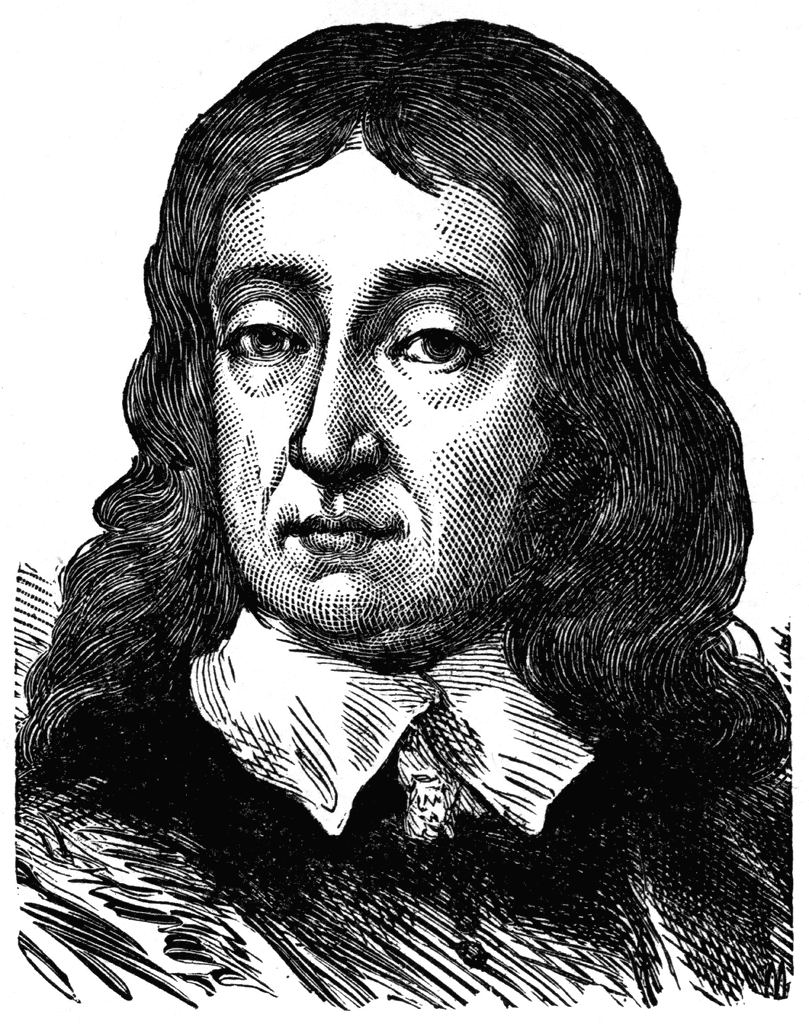
                               
                                     John Milton: Cold Porridge Poet

So I don’t know if I have a degree; but I do know I’ve left because I’m not going back to repeat the module if I’ve failed. I can’t afford to, and I would rather perform surgery on myself with a rusty flick knife. It was an interesting experiment, going to uni, and a nice way of burying the ghosts of my breakdown 30 years ago, when I was supposed to come to what was then Nene College but ended up retreating to my bedroom for three years instead. But I was probably too old when I enrolled in 2010 to feel a part of what they like to call “the university experience” (I’ve never been sure what that was); if I went back at the end of this year I’d been more than half way to 50 by the time I finished, assuming I did. (Imagine being stuck endlessly repeating the same boring module over and over again forever.) I’ve never had the right attitude for university either. I’m too critical of authority. Too critical of received wisdom. And too stubborn. The more you tell me that something is indisputably so, the less I will believe it, even if I know, in the small hours of the night, that you are right and I am wrong. The two most depressing words in the world, as far as I’m concerned, are “peer review”. I couldn’t give a fuck what anybody else thinks really, but lordy how much some of these scholars care about their status.

Oh, I had some good lecturers. Mark Brown was wonderfully charming and a fabulous communicator. I loved his lectures, despite his highly dubious obsession with Paul Auster and his dismissal of Jack Kerouac as “hippie shit”. Unfortunately, the callous bastard abandoned the university because he wanted to live closer to his family. Sonya Andermahr scared and infuriated half of her students with her utter intolerance of anybody who didn’t share her taste in literature or her feminist orientation; but I agreed with her on politics even if we diverged on books and it was refreshing to be exposed, once a week, to someone with such a razor-sharp intellect. Course leader Phillippa Bennett was always unflappably calm and in control, and I never saw her embarrass a student who hadn’t quite understood a question that she’d asked. And tattooed, dreadlocked Jaz Shadrack electrified a post-colonial class in year two that had been made comatose by a departing lecturer. Some may not have appreciated her political digressions – one student took to calling her “Citizen Jaz” – but were they even digressions, when the module was centred on literature responding to political oppression? Can you divorce Brick Lane from the role of women in Islamic society, for example? Of course you can’t.

Naturally, the fact that I agreed with her helped. If I’d had to sit for two hours a week listening to someone glorifying the British Empire or the healing power of global capitalism, I might have quit the university last January. It was hard enough to stick around when I was being told week after week by another lecturer that Bill Wordsworth was the best thing since the electric cheese grater. Actually, he’s a windy bore (the poet). The great Japanese haiku writers could say what he said, and say it better, in three lines; he took thirty pages. (By the way, Doc, it isn’t funny to say that Welsh people have sex with sheep, French people are intolerable and all Americans are stupid. Knock it on the head next year, mate.)

                                           Bill Wordsworth after reading his own poetry.

 The best part of university for me, and almost everybody says it, but it’s true, was that I met some nice people and we had some fun times together. That doesn’t sound like much when bloody wars are being fought, when two million children a year are dying of malnutrition, but actually, it’s everything. See what you remember most when you’re lying on your death bed about to gurgle your last. The days I spent with Martyna Hatton, seeing her through her pregnancy, the birth of her beautiful daughter Leila (I wasn’t there, but someone should make a film about it), and her fabulous Goth marriage to Kenny at the Sunley conference centre on Park campus, will stay with me until my mind lapses into amnesia and hallucination (I have about six months); and I so admired the way she ploughed on through the difficulties of the last year, I couldn’t even tell her without being patronising.  I loved getting to know Kerry Wilkinson too, whose university trajectory was almost the polar opposite of mine (if I’m not mixing metaphors) in that she started off poorly and then worked her arse off until she became one of the best students of the 2010 intake. We were united, at first, by our difficulties with Charles Bennett, the Creative Writing lecturer, who used a tea pot to demonstrate the eccentricity he wanted you to believe defined him, and set his own book as the mandatory text for students to purchase in year one. I still think that was immoral. Kerry argued with Bennett, and I fought with him so bitterly it became something of a popular sport for students to come along to our Wednesday classes and wait for the moment when the cork popped. I still feel that the spectacle of two old grey-haired bitches fighting over poetry while teens looked on degraded both of us.

But there were many people I met at uni who made the time worthwhile. Robert Davies is the most disciplined and yet the most intellectually independent man I’ve ever met. I saw him walking on his own through a dense crowd of protestors at the tuition fee march in London in 2010, holding a placard high in the air and looking absolutely at peace with himself. At his age I was hiding under a blanket in my bedroom. And when I asked him what his motivation was for coming on the march he said, “I’m here for my younger sisters.” Lucia Madalena Conte has the best and readiest laugh I’ve ever heard other than Rachel Lovesy’s, and she graces any company she’s in with her intelligence, her perfect manners (if that doesn’t make me sound about 90) and her interest in you; Christine Horne (I hope she won’t mind me saying this!) grew from what Allen Ginsberg called “wallflower anxieties” to be unexpectedly self-confident at the oddest moments and the person I always asked when I wasn’t sure of something; James Goswell disappeared to form a band in year three but even his smart-alec desire always to have the last word (identical to my own) didn’t detract from his affable manner and keen wit . I didn’t know Charlotte Farrow too well before she left to have her baby, but speaking to her since on Facebook I’ve found someone who, growing out of the same soil as me, I like very much. And there were others. But since I hate the long lists of names in Greek poetry, I’ll spare you any more in this.

As for my poet friend’s assumption that university would blunt my ability to write truly, independently, free of the starch of received academic wisdom – I know what he meant, and there was a certain amount of truth in what he said. An English degree does present you with an incredibly narrow, uninformed literary canon and train you to believe that’s all there is; anything else is not serious. Why was there no d.a.levy on the American Lit module? You can’t teach American poetry after 1960 without mentioning levy. And why was Don Delillo presented as the last word in modern American writing and not Wild Bill Blackolive? Is a book only worthy of academic consideration if it comes from a major publishing house? How on earth could Laurence Marriott not have heard of John Fante, or Charles Bennett warn me to avoid Charles Bukowski and read somnambulant English drears like himself instead?

                                         Buk. Stay away from anyone you can actually read.

And yet, I’ve ridden in labourers’ vans in muddy boots watching men drool over women’s tits in newspapers. I’ve worked in McDonald’s with zitty, brain-dead and probably impotent boys in white shirts telling me what to do. After long days of hard physical work it’s just as easy to pull a case of beer from the fridge and veg out in front of the television as it is to write poetry. But I didn't. If you’re ready to write, you’ll write; it doesn’t matter where you are. And whether you’re pulling a root up in an old lady’s garden with the snow falling on your frozen hands, or sitting in a warm classroom watching the sixth beautiful, pampered, middle-class kid in two hours do a presentation on gender in Jeanette Winterson, the honesty and the style in what you produce will depend on the honesty and style in you. University may be the monkey-see/ monkey-do mechanism that ensures the continuation of the existing power structure, or it may be, as the Tibetans would say in a different context, the Great Liberation through Hearing. But you, ladies and gentlemen, are your own responsibility.

I take me, now, out into the big bad world I was seeking refuge from when I enrolled at the university in 2010. No more education for Bard, at least not in the classroom. I may or may not have a degree, time will tell. I don’t even care, really, other than in the sense that it would be nice to have something to show for the giant debt I’ll have hanging around my neck like a fat badger corpse for the next 25 years. But all things considered, and generally in all the wrong ways, it’s been enlightening. Now the Vice Chancellor can sing love songs to Chinese Communism and have nobody point out the screams of the dying in Llhasa.

Saturday, April 13, 2013

An 80s Photo Gallery


"The struggle of man against power is the struggle of memory against forgetting" -
Milan Kundera.